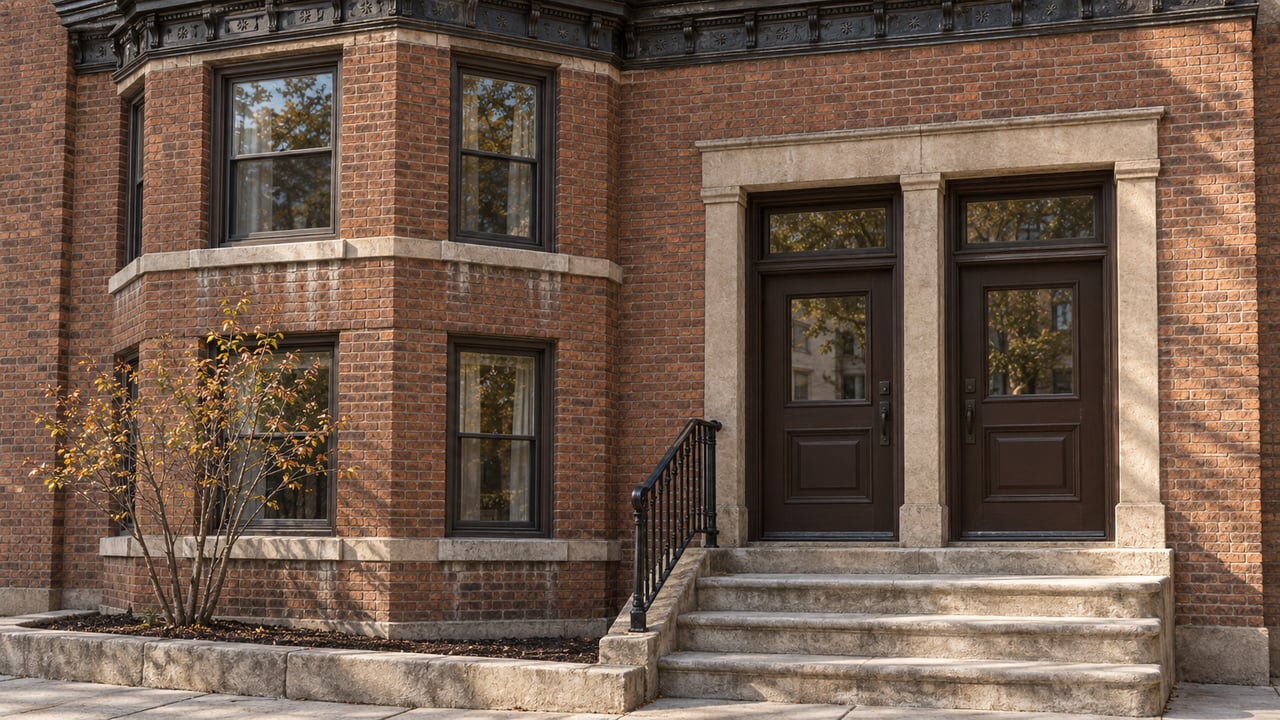
Logan Square Two-Flat Deconversion Ordinance: What Buyers Should Know
A two-flat near Logan Square's stretch of the 606 no longer comes with a demolition option in most cases. Since September 2024, Chicago's Northwest Side Housing Preservation Ordinance has made it permanently illegal, not simply expensive, to replace an existing two-, three- or four-unit building with a single-family home on any block where multi-family buildings already make up the majority. The math that used to matter, whether a buyer could stomach a demolition fee, isn't the math that decides these deals anymore.
That distinction gets lost in most summaries of the rule, which tend to lead with the dollar figure. The dollar figure is real. But on a majority multi-family block, the fee is moot, because the teardown isn't allowed at any price.
The current version of this policy replaced a three-year pilot. The Chicago Sun-Times reported that from 2021 through 2024, the city charged a $15,000 flat fee to demolish a detached house, townhouse or two-flat near the trail, and $5,000 per unit for larger buildings. Chicago's City Council Zoning Committee signed off on a permanent replacement in September 2024, and, as Chicago's Property Management reported, the numbers moved with it.
| Pilot ordinance (2021–2024) | Permanent ordinance (since 2024) | |
|---|---|---|
| Detached house, townhouse or two-flat | $15,000 flat | $60,000 flat |
| Multi-unit building | $5,000 per unit | $20,000 per unit |
| Coverage area | About 1.7 square miles | About 6 square miles |
| Status | Temporary, renewed twice | Permanent |
The footprint grew along with the fee. Chicago Cityscape's mapping of the district, last updated in July 2026, shows the boundary now runs roughly from Division Street to Addison Street and from Western Avenue to Pulaski Road, reaching into Logan Square, Avondale, Hermosa, Humboldt Park and West Town. A two-flat that sat just outside the old pilot zone may sit well inside the current one.
None of that is the part that should change how an investor underwrites a deal. The part that should is the "predominance of the block" test that travels alongside the fee. On any block where the majority of existing lots hold multi-family buildings, new single-family construction isn't permitted at all, meaning the deconversion play (buy a two-flat, gut it, sell it as one house) simply isn't on the table there regardless of what a buyer is willing to pay in surcharges.
The same ordinance runs the incentive the other direction. Two-flats are now allowed by-right on standard-size RS-3 lots, roughly 3,125 square feet, which removes a zoning-variance step that used to slow down anyone trying to add a legal unit to a lot that only supported one. As the Chicago Sun-Times reported, Ald. Carlos Ramirez-Rosa, who represents Logan Square's 35th Ward, described the pattern the ordinance was written to stop:
"Too many multi-family and courtyard buildings along the trail have been de-converted."
The rule doesn't just make subtraction expensive. It makes addition easier. For a buyer weighing a two-flat purchase near the trail, that's the more useful fact than the surcharge number, because it points to which project actually clears the zoning process without a fight.
Buyers and sellers of occupied two-to-four unit buildings in this corridor also need to budget for time, not just money. Chicago's tenant opportunity to purchase requirement, part of the same policy package, gives existing tenants a right of first refusal before a covered multi-unit building can be sold. Depending on building size, that process can add up to 270 days to a disposition timeline.
That's not a footnote for a seller who has already told a buyer to expect a 45-day close, or for an investor underwriting a 1031 exchange on a tight calendar. If the building is occupied and falls inside the mapped district, the purchase agreement needs to build in tenant notice and response windows before anyone can count on a closing date holding.
As Hoodline reported, a live example a few blocks from the trail shows how much friction still exists even for a project that adds density rather than removing it. A long-vacant former recovery center at 3601 W. Cortland St. has been moving toward a 42-unit apartment conversion since a developer, working through Key Development Partners, bought the site in November 2020. Chicago's City Council received a new rezoning application for the parcel in March 2026, and the project still needs approval of six separate zoning variances, including a parking reduction, before it can move forward. It isn't in a city-designated transit-served area, so it doesn't qualify for the parking breaks that apply within a half-mile of CTA rail stations under the city's Connected Communities Ordinance, even though it sits close to the Armitage and Pulaski bus lines and near the 606. Approximately fifteen percent of the units, six apartments, will be priced for households earning 60 percent of area median income to satisfy the city's Affordable Requirements Ordinance.
That is the version of Logan Square multi-family development that has to earn every variance one meeting at a time. It's also exactly why the by-right two-flat allowance inside the preservation district matters for a smaller buyer. A two-unit addition on a standard RS-3 lot skips the zoning board entirely. A 42-unit conversion on a non-conforming parcel does not, and can take years even when nobody objects to more housing existing.
None of this has cooled demand for holding rental property in the area. Multiple listing service data covering the three months ending in May 2026 put Logan Square's median sale price at $730,000, up 12.3 percent from the same period a year earlier, at roughly $393 a square foot. Rent-tracking cited in Hoodline's coverage of the Cortland Street project put Logan Square's average asking rent at $2,245 as of August 2026, an 11 percent jump from the year before.
Read against the ordinance, those two numbers make a specific case. A two-flat that can't legally become a single-family teardown is also a two-flat with rents climbing at double-digit rates and a fee structure that discourages competitors from thinning out the same rental stock. The building an investor already owns, or is trying to buy, holds its multi-unit character by law on most blocks near the trail, and the rent growth suggests that's not a bad place to be sitting.
Does the ordinance apply to every block in Logan Square? No. It applies within the mapped preservation district, which as of 2026 covers roughly six square miles from Division to Addison and Western to Pulaski, touching Logan Square, Avondale, Hermosa, Humboldt Park and West Town. A property's exact block matters, since the predominance test is measured block by block, not neighborhood-wide.
Is this still a temporary pilot I should expect to expire? No. The version in effect since September 2024 is a permanent ordinance, not a renewable pilot, and it replaced the earlier time-limited program.
Does the rule stop me from adding a unit, or only from removing one? It's built to reward addition. Two-flats are now allowed by-right on standard RS-3 lots inside the district, which is the opposite of the restriction placed on demolishing or deconverting existing multi-family buildings.
If you're weighing a two-flat purchase near Logan Square's stretch of the 606, whether as an owner-occupant, a first small-multifamily buy, or a disposition you're planning to list, the block matters as much as the building. Dwell Wisely Group works through that map with buyers and sellers before an offer gets written, so the numbers you're underwriting match what the zoning code will actually let you do with the building once you own it.
This article is general information, not legal, tax or financial advice. Consult a qualified professional about your situation.
Whether working with buyers or sellers, Dwell Wisely Group provides outstanding professionalism into making their client’s real estate dreams a reality. Contact the Dwell Wisely Group today for a free consultation for buying, selling, renting, or investing in Chicago.
Get in touch with our team to learn more.

1875 N DAMEN AVE CHICAGO IL 60647