West Town's Coach House Head Start: What Chicago's New ADU Law Actually Means Here
"For homeowners, there's going to be some difficulty ascertaining whether or not they're in an eligible geography, and then which rules have been applied to that geography."
That's planning consultant Steven Vance describing Chicago's new accessory dwelling unit ordinance, the one that legalized coach houses, basement units and attic conversions across most of the city when it took effect on April 1, 2026. Vance has spent years mapping this rollout, and his warning is accurate for most of Chicago. It is largely beside the point for a West Town two-flat.
The headline version of this story is "Chicago legalized ADUs citywide." The real version is narrower and more interesting. City Council voted 46-0 on September 25, 2025 to approve the expansion, but what actually became legal by right, with no alderman's signature required, was ADUs on any lot zoned RT or RM, the classifications for two-flats, townhouses and multi-unit buildings. Everywhere else, in the single-family RS zones that make up most of the city's residential land, a coach house is only legal if the property sits inside one of the five original 2021 pilot zones or if the local alderman has since opted that block in. As of this spring, 34 of the city's 50 wards had opted in some or all of their single-family blocks. Fourteen had not.
West Town's housing stock sidesteps most of that fight. The neighborhood is built out of two-flats, three-flats, greystones and worker's cottages, the exact building types the RT designation exists to describe. For a buyer or investor evaluating a listing here, that is the thesis worth carrying into the search: the coach house question in West Town is usually a zoning-classification question, not a wait-and-see-what-your-alderman-decides question.
The ordinance reads as a single law, but it behaves as two separate systems depending on what's already zoned on the lot.
| Zoning situation | ADU status as of April 1, 2026 | Who signs off |
|---|---|---|
| RT or RM (two-flat, townhouse, multi-unit) | Legal by right, citywide, outside downtown | No aldermanic approval needed |
| RS, inside one of the five original 2021 pilot zones | Legal, carried over from the pilot | No new approval needed, though North and Northwest pilot lots do not carry over the per-block caps or owner-occupancy mandate that West, South and Southeast pilot lots do |
| RS, outside the original pilot zones | Legal only where the alderman has opted the block in | Alderman's ordinance required, plus whatever caps or occupancy rules that alderman attaches |
That second row matters specifically for West Town. A portion of the neighborhood sits inside what the city calls the Northwest Pilot Zone, established in 2021 alongside four other pilot areas. The city's own FAQ on the permanent ordinance singles out only the West, South and Southeast pilot zones for carryover restrictions, meaning a per-block cap on new permits and a requirement that the owner live on site. Northwest is not on that list. A single-family lot in West Town's slice of the Northwest zone gets the same by-right treatment as an RT-zoned two-flat down the block, without the occupancy string attached in three of the other four original pilot areas.
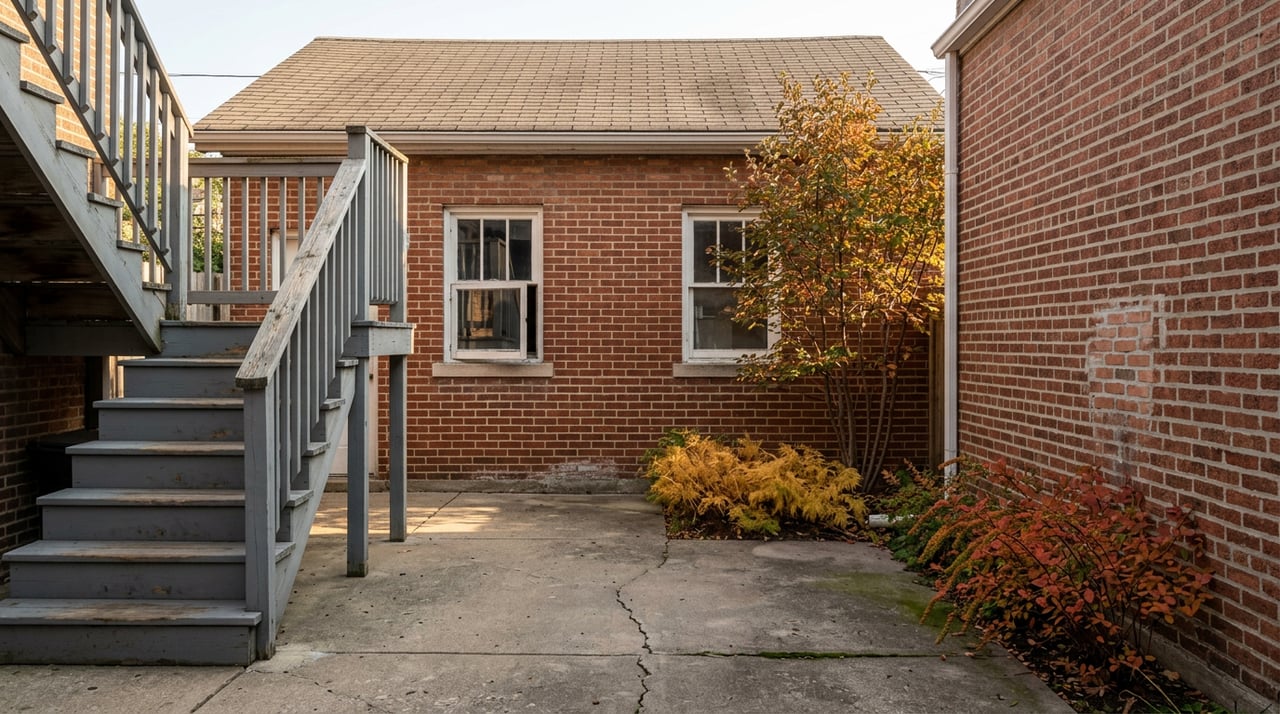
Walk the MLS listings in West Town and the adjacent Noble Square and East Village pockets right now and coach houses aren't a hypothetical. One listing markets a fully renovated four-unit brick building with two units in the main structure and two more in a rebuilt coach house behind it. Another, a two-flat, is pitched straight at investors and owner-occupants as a classic West Town hold. A third property nearby carries a non-conforming coach house that predates the current ordinance entirely, the kind of structure that's been quietly doing this job since before 1957, when the city banned new construction of exactly this type.
That last point is worth sitting with. The ordinance didn't invent coach houses in West Town. It legalized building new ones and legalizing the ones that already exist. For a buyer touring a three-flat with an old rear structure on the lot, the question shifting from "is this legal" to "what does it take to bring this current" is a meaningfully different conversation with a lender or a contractor.
The ordinance created two paths, and they carry different price tags and different rules.
| Coach house (detached) | Conversion unit (basement or attic) | |
|---|---|---|
| Typical build cost | Roughly $150,000 to $300,000 | Roughly $80,000 to $150,000 |
| Building age requirement | None | Principal building must be at least 20 years old |
| Height limit | 22 feet, measured to the highest point | N/A |
| Lot placement | Must sit within the rear 50 percent of the lot | N/A |
| Parking required | None | None |
| Contractor requirement | Must use a firm enrolled in a federally recognized labor apprenticeship program | No apprenticeship mandate |
| Ceiling height minimum | N/A | 7 feet 6 inches throughout the habitable space |
That apprenticeship requirement for new coach house construction, absent for basement and attic conversions, is one of the quieter frictions in the ordinance. It was the compromise that got skeptical alderpeople to vote yes, and it means a homeowner choosing between a new detached coach house and converting an existing basement is also choosing between a narrower contractor pool and a wider one. Citywide, average rents for these units run roughly $1,450 to $1,950 a month for a one-bedroom and $1,850 to $2,600 for a two-bedroom, though West Town's own rental comps will vary block by block.
A few numbers and steps are worth confirming with your agent before you assume a West Town listing carries coach house upside.
The volume of interest since April suggests this isn't a niche question. Ald. Bennett Lawson, the ordinance's lead sponsor, has said the city received 126 ADU applications in a single week that spring, roughly equal to what the entire final year of the pilot program produced. That's a market signal as much as a policy footnote.
Does adding a coach house or conversion unit change how my West Town two-flat is classified for tax purposes? It can. A property gaining an interior ADU may see its classification shift, which affects the assessed value calculation. The Home Improvement Exemption can delay the impact of that shift for up to four years, but it's worth asking your accountant or the assessor's office how it applies to your specific parcel before closing.
Can a West Town coach house be listed on Airbnb or a similar platform? No. Units built under this ordinance cannot be rented for stays under 30 days, regardless of zoning classification or pilot area. This is a long-term housing tool, not a short-term rental one.
If a property in West Town is zoned RS rather than RT, does it automatically qualify? Only if it falls inside the original Northwest Pilot boundary or if the alderman for that block has separately opted the area in. Don't assume coach house potential just because the address says West Town. Ask your agent to check the parcel's specific zoning and eligibility before you factor it into your offer.
If you're weighing a West Town two-flat against something in a neighborhood still waiting on its alderman to decide, that's exactly the kind of structural difference the median price won't show you. Dwell Wisely Group works these numbers block by block for buyers, sellers and investors across West Town and the surrounding neighborhoods. Schedule a free consultation and we'll walk the specific parcel with you before you write anything down.
Whether working with buyers or sellers, Dwell Wisely Group provides outstanding professionalism into making their client’s real estate dreams a reality. Contact the Dwell Wisely Group today for a free consultation for buying, selling, renting, or investing in Chicago.
Get in touch with our team to learn more.

1875 N DAMEN AVE CHICAGO IL 60647